P999 Game Download APK | Latest Version Free For Android

If you’ve spent any time scrolling YouTube, TikTok, or WhatsApp groups lately, chances are you’ve bumped into P999. Maybe a friend sent you a link. Maybe an ad promised you a free bonus just for signing up. Maybe you searched “P999 game real or fake” because something about it didn’t sit right. Whatever brought you here, this article is going to give you a straight answer, not a sales pitch.
There’s a strange thing happening with P999 online. Type the name into Google and you’ll find dozens of articles that read almost like advertisements — download buttons, login walkthroughs, deposit guides, “how to win big” tips, all wrapped in cheerful language about earning real money from your phone. What you won’t find, in most of those articles, is a plain conversation about what P999 actually is, how it fits into the law, and what happens to people who get pulled into platforms like it.
That’s what this piece is for.
So What Exactly Is P999?
P999, sometimes written as P999 Game, P999 Latency, or P999 Bet, is a mobile and web-based app that mixes casino-style games with a promise of real-money earnings. Inside the app you’ll typically find slot machines, card games like Teen Patti, fishing-style games, and simple luck-based mini-games such as Aviator or Crash clones. The pitch is always the same: play, win, withdraw your winnings, and along the way earn extra through daily bonuses, tournament prizes, and referral commissions for inviting friends.
It markets itself heavily to users in Pakistan and Brazil, and it isn’t the only app of its kind. It sits in a crowded family of similar platforms — names like Y999, GH88, 92PKR, and dozens of near-identical clones — that all follow the same basic playbook. New app, same games, same bonus structure, same promise that anyone can turn a smartphone into an income source.
If that sounds appealing, it’s meant to. These apps are built by people who understand exactly what makes an offer hard to scroll past: free money, no upfront cost, and a friend who says it worked for them.
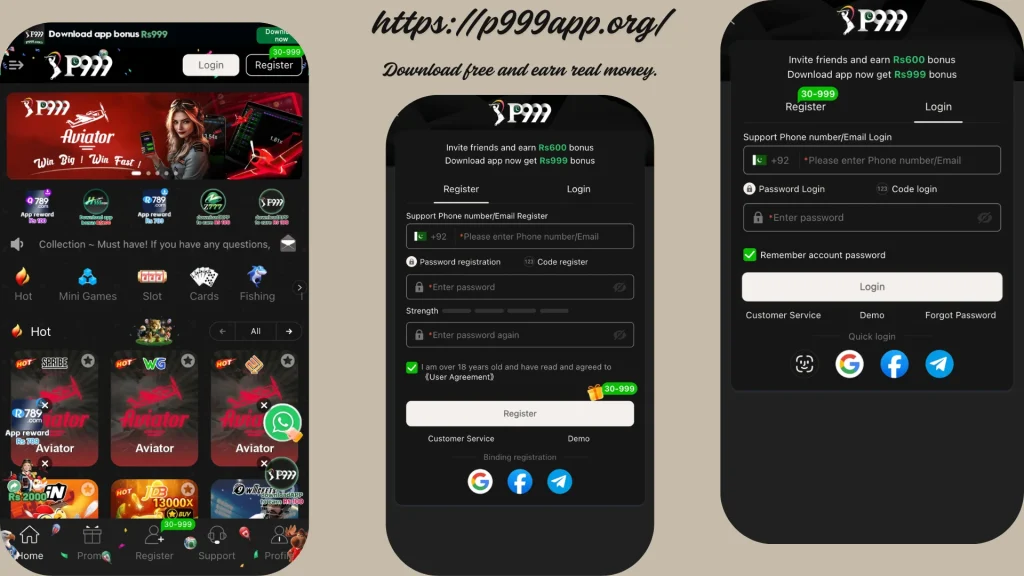
Features of P999 Game Money Earning Platform
Smart Gameplay
The AI in P999 latency helps make the game more enjoyable by providing smooth and intelligent gameplay. It responds quickly to player actions, making the game feel more interactive and exciting. This creates a better gaming experience for both new and experienced players.
Easy-to-Use Interface
P999 latency has a simple and user-friendly design. The menus, buttons, and controls are easy to understand, so players can start playing without any difficulty. Even beginners can learn how to use the game in a short time.
Fast Performance
The AI helps the game run smoothly with fewer delays and quick loading times. Players can enjoy a better experience because the game responds faster to their actions. This makes gameplay more enjoyable and reduces interruptions.
Fair and Balanced Gameplay
The AI is designed to make the game fair for everyone. It follows the same rules for all players and helps maintain balance during gameplay. This creates a more competitive and enjoyable environment where players can rely on their skills.
Regular Updates and Improvements
The developers regularly update the game to improve its performance and fix any problems. These updates may include bug fixes, better security, and new features. As a result, players can enjoy a more stable and improved gaming experience over time.
Compatible with Different Devices
P999 Game is designed to work on many Android devices. It is lightweight and does not require a very powerful phone to run smoothly. This allows more people to enjoy the game without needing expensive hardware.
Better User Experience
The AI helps improve the overall user experience by making navigation simple, reducing errors, and providing smooth gameplay. It also helps the game perform consistently, making it more enjoyable for players who want a fun and easy gaming experience.
The Question Nobody’s Really Answering: Is It Legal?
Here’s where most of the existing coverage of P999 gets slippery. Article after article dances around the word “casino” and instead calls it an “earning platform” or a “gaming app.” That’s not an accident. Calling something a casino invites a legal conversation that these sites would rather avoid.
Let’s have that conversation anyway.
In Pakistan, gambling is not in a legal grey zone — it is explicitly illegal. The Prevention of Gambling Act of 1977, itself based on the colonial-era Public Gambling Act of 1867, bans gambling activity outright, with only a narrow carve-out for tote betting on horse racing at licensed racetracks. There is no path for an app like P999 to obtain a Pakistani gambling license, because no such license exists to give out. Any platform offering slots, card games, or betting for real money to Pakistani users is operating outside the law, full stop.
This isn’t just a technicality sitting quietly in an old law book, either. Pakistan’s cybercrime authority, the National Cyber Crime Investigation Agency, has been actively working through a list of gambling and betting apps and formally declaring them illegal, then instructing the Pakistan Telecommunication Authority to block them. In one sweep alone, dozens of casino and betting apps were named and forwarded for blocking, alongside a batch of unregulated trading platforms that ran the same “sign up and earn” style of marketing. The agency’s stated concern wasn’t just gambling itself — it was that many of these apps were also collecting personal data and phone numbers without proper consent, folding a privacy problem into the gambling problem.
P999 specifically hasn’t been the subject of a splashy news headline the way some bigger international brands have. But that’s not the same as being cleared. It means P999 hasn’t attracted the same level of attention yet — not that regulators have looked at it and given it a pass. Given that its entire business model is built on real-money casino games offered to Pakistani users without any visible license, it falls squarely into the same legally unauthorized category as the apps that have already been named and blocked.
If you’re in Pakistan, using an app like this carries genuine legal exposure, not just the risk of losing money. Courts and enforcement agencies have shown they’re willing to treat online gambling as seriously as in-person gambling, and the direction of travel — more crackdowns, more app bans, more scrutiny of payment methods — has been consistent for the past couple of years, not softening.
“Real or Fake” Is the Wrong Question
A lot of the search traffic around P999 comes from people typing some version of “is P999 real or fake.” It’s an understandable question, but it’s also a bit of a trap, because it assumes there are only two possible answers: either the app pays out and everything’s fine, or it’s a total scam that steals your money outright.
The reality with platforms like this is messier, and honestly, that messiness is part of how they keep operating.
Most apps in this category do pay out something, at least early on. Small, quick withdrawals in the first few days are common, and they’re not an accident — they’re a deliberate part of the design. A user who cashes out a small win early becomes a believer. They tell friends. They deposit more next time. They stop reading the fine print. This isn’t unique to P999; it’s a well-documented pattern across the entire category of “earning game” apps that have popped up across South Asia over the last few years, often built on nearly identical templates with different logos slapped on top.
Whether an app is technically “real” in the sense of occasionally paying users, and whether it’s a safe, fair, sustainable way to make money, are two completely different questions. An operation can hand out small payouts consistently and still be running an unlicensed gambling business with house-edge games engineered so that, over time and across its whole user base, the platform comes out ahead. That’s not a bug in the system. That’s the entire business model of every casino game ever built, legal or not.
So instead of asking “is P999 real or fake,” a more useful question is: who is actually running this, are they licensed anywhere, and what happens if something goes wrong? For P999 and its lookalikes, the honest answer to all three is: unclear, no, and you’re mostly on your own.
Who’s Actually Behind It?
This is one of the most consistent red flags across the entire “P999-style” app category, and it’s worth sitting with for a moment.
Search for the company behind P999 and you won’t find a registered gambling operator, a named executive team, a physical office address, or a regulatory license number the way you would with a legitimate international betting brand. What you’ll find instead is a cluster of near-identical domains — different top-level extensions, different front-end skins, same backend, same games, same bonus language — with ownership that’s difficult or impossible to trace. Some of the marketing copy around P999 even describes it as an “updated version” of a previous platform, which is a pattern worth noticing: when one branded app starts drawing negative attention, drawing complaints, or getting flagged, it’s common for the same operation to quietly relaunch under a new name.
That kind of structure isn’t necessarily proof of outright fraud on its own. But it does mean that if something goes wrong — a withdrawal that never arrives, an account that gets locked right before a big cash-out, a “verification” step that asks for more and more personal information — you have essentially no one to hold accountable. There’s no regulator you can file a complaint with. There’s no licensing body that can fine the operator or force a refund. There’s no customer protection framework standing behind your deposit, the way there would be with a bank or a licensed financial product.
How These Apps Actually Make Their Money
It helps to step back and think about the business model in plain terms, because the marketing language tends to obscure it.
Every casino-style game, whether it’s a slot machine, a Crash-style multiplier game, or a card game, is built with a mathematical edge in favor of the house. That’s not a conspiracy theory — it’s simply how the games are designed to be profitable for whoever built them. Individual players can and do win in the short term. That’s part of the design too; occasional wins are what keep people playing. But across thousands of users and millions of spins, the math consistently favors the platform, not the player.
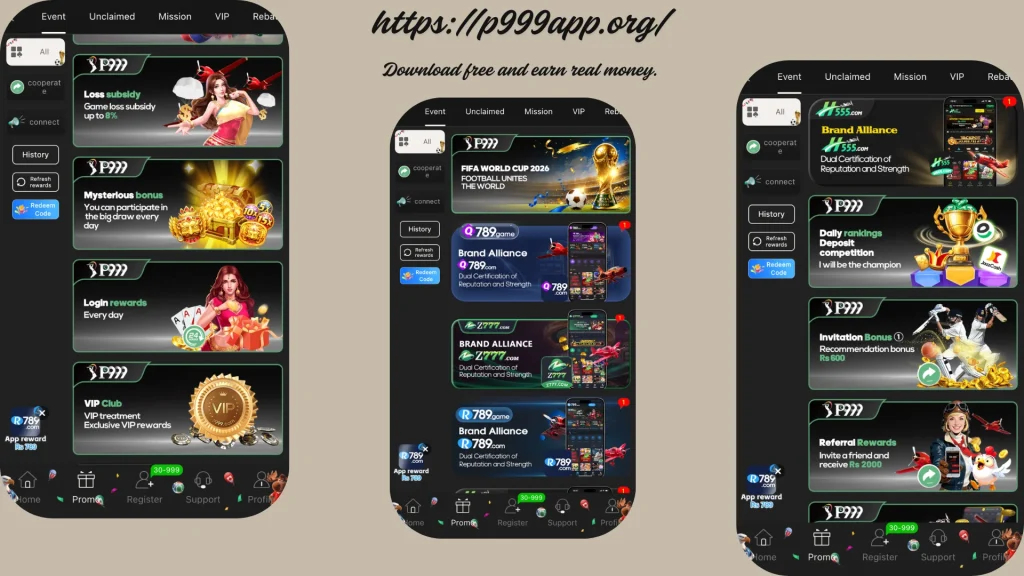
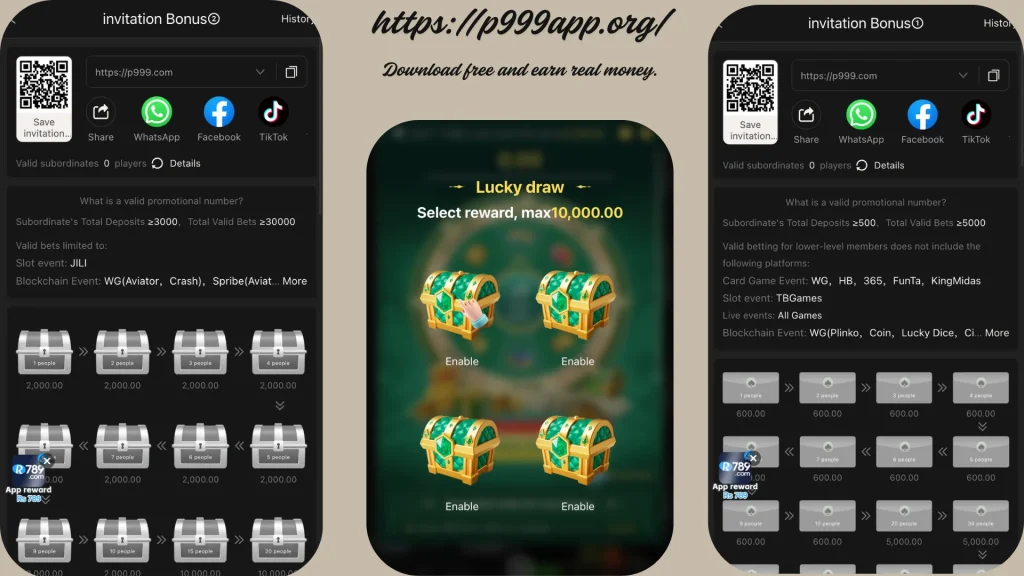
On top of the built-in house edge, apps like P999 layer a referral system, where existing users earn a commission for bringing in new depositors. This turns every user into an unpaid marketer and creates a structure that starts to resemble a pyramid, where the platform doesn’t just profit from gambling losses, it also profits from the constant recruitment of fresh depositors needed to keep bonuses and referral payouts flowing.
Bonuses, “welcome gifts,” and daily login rewards serve a similar function. They’re not generosity. They’re an acquisition cost, the same way a coffee shop might hand out a free sample to get you through the door. The cost of that free sample is baked into the price of everything else you buy afterward — except here, “everything else” is you gambling with an app that has a built-in mathematical edge against you.
None of this makes P999 unusual. It makes it fairly ordinary, as far as this entire category of app goes. That’s actually the more concerning part: there’s nothing about P999 that suggests it’s a uniquely bad actor. It looks and behaves like dozens of other apps that have already been investigated, flagged, or banned.
The Data Privacy Angle People Overlook
Money isn’t the only thing at risk here, and this part tends to get less attention than it deserves.
To use an app like P999, you typically need to hand over a phone number, sometimes an ID for “verification,” and payment details tied to services like EasyPaisa or JazzCash. Regulators looking into this exact category of app in Pakistan have specifically flagged that many of them collect personal data and contact details without clear consent, and that this data doesn’t necessarily stay contained within the app. Phone numbers harvested this way can end up feeding spam campaigns, SIM-swap attempts, or being resold entirely.
Because these platforms typically operate without a license and without a data protection framework holding them accountable, there’s no meaningful way to know where your information goes after you hand it over, or to compel anyone to delete it if you change your mind. If you’ve ever wondered why you suddenly started getting gambling-related spam calls and texts after installing an app like this, that’s very often the mechanism.
What the Reviews Actually Say, Once You Filter the Noise
A lot of the content ranking for P999 reads suspiciously similar to itself — the same phrases about “100 percent authentic,” the same claims of “zero risk,” the same enthusiastic tone about referral earnings. That similarity isn’t a coincidence. A good chunk of the top-ranking content for terms like this is written specifically to funnel downloads, sometimes by people earning a commission for every install or deposit they generate. It’s marketing dressed up as journalism.
Independent review platforms tell a more mixed story. On general consumer review sites, P999 shows up with only a small handful of reviews, not the volume you’d expect from a platform claiming huge popularity, and the sentiment among genuine users tends to be split between people reporting smooth small withdrawals and people reporting frustration around account verification, delayed payouts, or difficulty reaching support once a problem came up. That pattern — easy small wins, friction the moment you try to pull out anything substantial — shows up again and again across this entire category of app, not just this one.
If you read enough of these reviews with a skeptical eye, a consistent shape emerges: things feel great in week one, and things get complicated exactly when the money involved starts to matter.
Red Flags Worth Knowing, Not Just for P999 but for Any App Like It
You don’t need to memorize a checklist to protect yourself here. A few honest questions will usually tell you most of what you need to know.
Is there a real, named company behind the app, with a physical address and a licensing body you can actually verify? If a website only lists a WhatsApp number and a vague claim of being “100% authentic,” that’s not verification, that’s marketing copy pretending to be verification.
Does the app promise earnings with no real skill or effort involved, framed almost entirely around luck? Legitimate income sources, even flexible gig-style ones, generally require some form of labor, skill, or service in exchange for pay. An app that promises money mostly for logging in, spinning a wheel, and inviting friends is describing a gambling and recruitment structure, not a job.
Does the platform lean heavily on referral bonuses as a core part of its pitch? A referral program isn’t automatically a scam, but when referral income is presented as one of the main ways to earn — sometimes bigger than the games themselves — that’s a sign the business depends on constant recruitment more than it depends on a genuinely fair product.
Are early withdrawals fast and easy while later ones get harder, slower, or tangled in extra “verification” steps? This is one of the oldest patterns in the book, precisely because it works. Fast early payouts build trust. That trust is then spent.
Is the operator’s identity, location, and licensing status something you can independently verify through a government or regulatory database, rather than something you just have to take the app’s word for? If the answer is no, you are trusting people you cannot identify with your money and your personal data.
P999 checks several of these boxes, based on everything currently visible about how it operates and markets itself. That doesn’t require dramatic language to explain — it just means the ordinary cautionary questions apply here the same way they’d apply to any other app making similar promises.
If You’ve Already Used P999
If you’ve already installed the app, deposited money, or shared it with friends, you’re not alone, and there’s no need to panic. A calm, practical response matters more than guilt here.
Start by treating any money still sitting in the app as money you may not be able to recover in full, and make decisions from there rather than from the hope of one more big win to make up for it. If you’re able to withdraw your balance, doing so now rather than continuing to play is generally the more protective choice, since payout friction tends to increase the longer an account stays active and the more money moves through it.
Take a look at what permissions the app has on your phone — contacts access, SMS access, storage access — and consider revoking anything that isn’t strictly necessary, since some earning apps request far more access than their stated function requires. If you used a payment method that’s connected to your bank account rather than a prepaid mobile wallet, it’s worth keeping an eye on your statements for a while afterward, simply as a precaution.
If you referred friends or family, it’s worth being honest with them about what you’ve since learned, rather than letting the referral chain keep growing on the strength of your earlier recommendation. That’s not an admission of wrongdoing on your part — plenty of people get pulled into these apps through friends they trust, exactly because the whole design leans on trust as its main marketing tool.
And if you’re in Pakistan and something has gone seriously wrong — money that seems to be gone for good, harassment tied to a loan or deposit, personal data clearly being misused — the National Cyber Crime Investigation Agency does accept complaints related to cybercrime and unregulated financial platforms, and is the appropriate body to contact rather than trying to resolve things through the app’s own support channels alone.
Why the “Earning App” Category Has Exploded
It’s worth zooming out for a second, because P999 isn’t really the story here. It’s one branch of a much bigger trend.
Across South Asia and parts of Latin America, the last few years have seen a genuine explosion of these hybrid casino-and-earning apps. Economic pressure plays a real role in why they spread so fast — when the cost of living rises faster than wages, and formal job opportunities feel scarce or slow-moving, the promise of quick money from a phone becomes much harder to dismiss out of hand, even for people who’d normally be cautious. Add in aggressive social media marketing, testimonials from friends who genuinely did win something small early on, and slick app design that mimics legitimate fintech products, and you get a category that spreads through word of mouth faster than regulators can keep up with it.
That’s exactly why enforcement agencies in Pakistan have shifted their approach over the past couple of years, moving from occasional physical raids toward more systematic digital tracking and app-blocking campaigns. It’s also why dozens of apps in this exact category have already been formally named and blocked, with more reviews ongoing. P999 fits the profile of an app that could reasonably end up on a future version of that list, given how closely it mirrors the ones that already have.
A Fair Way to Think About the Whole Category
None of this means every single person who’s used P999 or a similar app has been defrauded, or that every review of it is dishonest. Plenty of ordinary people have played, withdrawn a small amount, and walked away without major harm. That’s true, and it’s worth acknowledging rather than pretending the picture is uniformly dark.
But “some people got away clean” isn’t the same as “this is safe.” Casino games are designed so that some people winning, especially early and especially small, is entirely compatible with the platform being structurally set up to take more than it gives back over time. A fair way to think about it is closer to how you’d think about any unlicensed financial product: the fact that it hasn’t collapsed yet, and the fact that some users have had a fine experience, doesn’t tell you much about whether it’s a good idea, or whether it will still be paying out reliably in six months.
If you enjoy games of chance and want to engage with them, that’s a personal choice worth making with full information — not through an app whose ownership you can’t verify, operating outside the law in the country where you live, requesting more personal data than it needs, and built on a bonus and referral structure specifically engineered to get you to stop asking questions.
Why This Matters Beyond Just One App
It’s tempting to treat a piece like this as being only about P999, but the more useful takeaway is the pattern itself. New apps in this exact mold appear constantly, usually with a name that sounds almost identical to whichever platform got the most attention the month before — a single added digit, a different suffix, a slightly different color scheme. The underlying product rarely changes. The games are frequently licensed from the same small handful of software providers, repackaged behind different logos, then marketed through the same playbook of welcome bonuses, referral chains, and testimonials from users who happened to win early.
Recognizing that pattern is more valuable than memorizing any one app’s name, because the name will change again next year. What won’t change is the underlying math of a house-edge game, the legal status of gambling in a country where it’s explicitly prohibited, and the basic risk of handing money and personal data to an operator you can’t identify or hold accountable.
If someone sends you a link to the “next P999,” the same questions apply: who runs this, is it licensed anywhere, what happens if a withdrawal doesn’t go through, and why does an app about games need my ID and my contacts list. Those four questions will tell you almost everything you need to know, regardless of what the app happens to be called.
The Bottom Line
P999 is a real-money casino-style earning app, marketed heavily to users in Pakistan and Brazil, offering slots, card games, and luck-based mini-games alongside bonuses and referral rewards. It operates without any visible license, in a country where online gambling is explicitly illegal, and it shares nearly every structural feature — anonymous ownership, fast early payouts, referral-driven growth, heavy data collection — with dozens of similar apps that Pakistani cybercrime authorities have already investigated and blocked.
It isn’t necessarily an outright scam in the simplest sense of the word, and it isn’t a safe, verified earning platform either. It sits in the same uncomfortable middle ground that most apps like it occupy: functional enough to keep users coming back, unaccountable enough that if something goes wrong, there’s no one you can turn to.
If you’re trying to decide whether to download it, that gap between “it works, for now” and “it’s safe” is really the whole answer. The most honest thing anyone can tell you about P999 is not whether it’s real or fake, but that the question itself is a distraction from the more important one: who is actually holding your money, and what happens to you if they decide to stop giving it back.
FAQs